News
Food Safety in Industry: A Shared Responsibility That Begins with Design and Advances Through Innovation
- 03/08/2026
- Innovation
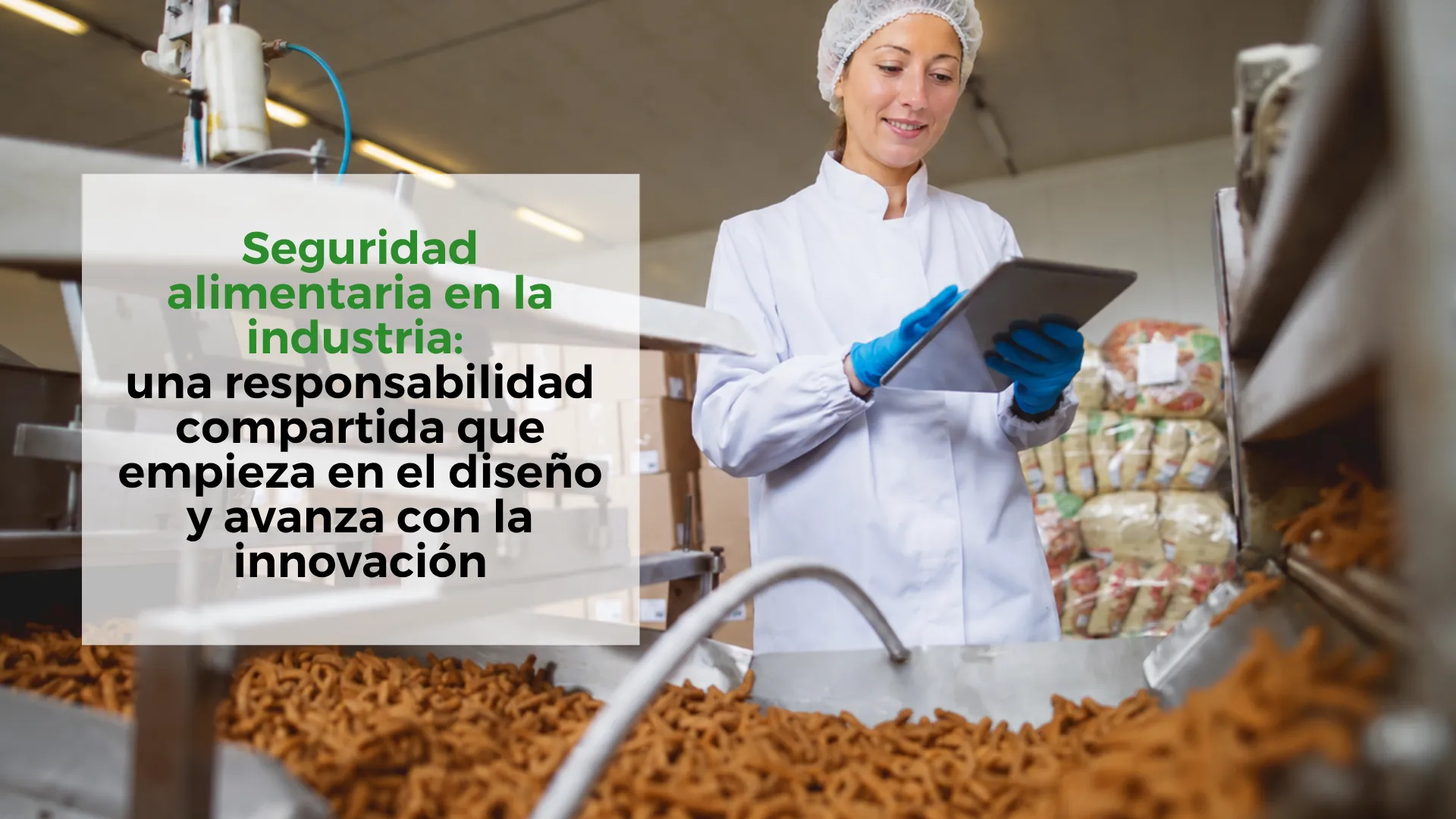
Food safety in industry is a responsibility shared by the entire chain: suppliers, plant personnel, technical teams, carriers, distributors and management. Ensuring it requires the integration of hygienic design, process control, traceability, cleaning, maintenance, training and a genuine preventive culture. Drawing on our experience in the agri-food industry of the Valencian Community, we analyse how every technical decision helps protect the product and maintain consumer confidence.
By Ana González, CEO and Agricultural Engineer – Industrial consultant specialising in energy efficiency and grant management at AGB Ingeniers
After so many years working with agri-food industries in the Valencian Community, I have seen that food safety does not depend on a single measure or a single department. It is built every day through many coordinated decisions: from selecting suppliers and designing facilities to cleaning, maintenance, staff training, traceability and the control of every process. The entire chain shares the same responsibility: protecting the product and maintaining consumer confidence.
When I enter a plant, I do not only observe machinery or production lines. I analyse routes, contact areas, temperatures, the movement of people, raw-material flows and potential risk points. Very often, what makes a facility genuinely safe is not one major visible action, but the sum of many small details that have been properly resolved, together with a corporate culture that understands prevention as part of its daily activity.
There is also considerable scope for innovation in industrial food safety. The digitalisation of records, sensors, real-time monitoring, automated controls and intelligent traceability systems make it possible to detect deviations earlier, obtain more reliable information and act more quickly. Innovation does not mean incorporating technology simply because it is fashionable, but using it to improve the ability to prevent, control and make decisions.
Innovation can also be incorporated into the design of the industry itself: equipment that is easier to clean, flows that prevent crossovers, more stable refrigeration systems, hygienic materials, more accessible controls or processes that reduce handling. At AGB Ingeniers, we understand food safety as a constantly evolving field in which engineering, experience and innovation must work together to build safer, more efficient industries that are prepared for the future.
Food safety begins before production starts
When I enter a food industry facility, I do not only see a building, a production line or a set of machines. I see routes, crossovers, temperatures, cleaning points, raw-material entry points, the movement of people and areas in which an apparently minor decision can influence the entire process.
The consumer does not see this reality. They see a packaged food product, a label and a use-by date. They naturally trust that the product has been prepared correctly and will reach their table in safe conditions. That trust is supported by a technical structure that is rarely visible from the outside: hygienic design, procedures, controls, maintenance, traceability and people trained to detect any deviation.
The Official Association of Agricultural Engineers of Levante accurately defines it as "an invisible architecture of technical decisions". Safety is not achieved solely through a final inspection; it is built through the design of spaces, equipment, cleaning circuits and control systems.
After years working with agri-food industries in the Valencian Community, I am increasingly convinced that a safe plant is not simply one that passes an audit. It is one that has integrated food safety into its everyday operations.
The layout plan is also part of food safety
Many critical decisions are made while the facility still exists only on paper.
The location of a door, the separation between a clean area and a dirty area, the route followed by raw materials, staff access, waste removal or the position of a drain can either facilitate hygiene or create problems that will remain with the company for years.
In a fruit and vegetable processing centre, for example, it is necessary to understand how the product enters, how it is unloaded, washed, graded, packed and dispatched. In a processing industry, we must analyse the movement between raw materials, production, treatment, packaging and finished products. It is also essential to study water, air, ventilation, industrial refrigeration and the surfaces that will come into contact with the food.
That is why I always insist that hygienic design is not an addition that can be resolved at the end. A well-planned facility makes cleaning easier, reduces crossovers, improves controls and enables personnel to work correctly. A poorly organised facility forces the company to compensate for its shortcomings through more complex procedures and constant supervision.
Cleaning is not enough: it must be possible to clean properly
During many technical visits, I notice that cleaning is discussed as a task, when it should also be understood as a design condition.
A machine may operate perfectly from a production perspective and yet contain inaccessible corners, water accumulation, surfaces that are difficult to inspect or components that require excessively complex dismantling. Under these conditions, cleaning properly requires more time, more resources and much greater operational discipline.
The industry must ask whether its facilities make it possible to see, reach, dismantle, drain and verify. It must also control aspects such as pests, waste, suppliers, raw materials, allergens, temperatures, storage, transport, equipment calibration and preventive maintenance. All these elements act as prerequisite programmes on which the HACCP system is subsequently based.
When these foundations work properly, control no longer depends on reacting to a problem and instead becomes prevention.
HACCP: anticipating problems before something goes wrong
The Hazard Analysis and Critical Control Points system, known as HACCP, helps identify the relevant risks within a process and establish specific measures to keep them under control.
It is not about producing documentation simply to comply with requirements. It is about analysing what could happen, where a deviation could occur, how it would be detected and what the company would need to do to correct it before it affected the consumer.
European regulations place primary responsibility for food safety on the food business operator and require permanent procedures based on the principles of HACCP. Good hygiene practices and prerequisite programmes form the foundation on which this system is developed.
In my experience, a genuinely useful HACCP system must be adapted to the plant and its process. It cannot be a generic document disconnected from what happens in production. It must speak the same language as the company and be understandable to the people who apply it every day.
Traceability: knowing what happened and being able to act
Traceability is another of the pillars that consumers do not see. Each batch must be linked to its raw materials, suppliers, processes, controls and destination.
When everything works properly, these records may appear routine. However, if an incident occurs, having accurate information makes it possible to locate the product, define the scope of the problem and act quickly. Poor traceability turns a limited problem into a much more complex situation.
In the industries we work with, digitalisation is making this control easier. Sensors, management software, readers, automatic recording systems and monitoring tools make it possible to gather information that was previously recorded manually. However, technology does not replace professional judgement: data must be reliable, interpretable and useful for decision-making.
A food safety culture is demonstrated every day
We can design an excellent facility and draft rigorous procedures, but nothing will work if people do not understand why they must apply them.
Food safety is put to the test during shift changes, periods of peak production, an unexpected breakdown or when a campaign requires the company to work more intensively. It is at these moments that we see whether procedures form part of the company culture or are regarded only as a documentary obligation.
A food safety culture requires management commitment, clear communication, continuous training, sufficient resources and genuine staff participation. Verification must be supported by objective evidence, such as hygiene practices, training, audit results, microbiological analyses and the monitoring of non-compliance.
I have seen plants evolve considerably when their teams understand that reporting an anomaly does not create a problem, but prevents a larger one from occurring.
Food safety also improves the company
Food safety is sometimes presented as a cost or as a requirement that limits production. My experience suggests the opposite: when it is properly integrated, it helps organise the industry.
Better-defined flows reduce unnecessary movements. Preventive maintenance avoids downtime. Properly designed cleaning saves time. Good traceability facilitates management. Reliable temperature control protects the product. A trained workforce detects deviations earlier.
For this reason, working on food safety also means improving processes, reducing losses, protecting the company’s reputation and strengthening the confidence of customers and distributors.
The role of AGB Ingeniers
At AGB Ingeniers we support agri-food industries in the Valencian Community through an integrated approach. We analyse the activity, processes, facilities and real needs of each company.
Our work may begin with the design of a new plant, an expansion, the reorganisation of flows, the installation of a production line or the modernisation of refrigeration, ventilation, water or energy systems. In all these projects, food safety must be present from the outset.
True preventive engineering ensures that risks have been considered before they appear. When an industry operates normally, the product is safe and no incidents occur, it may seem that nothing has happened. But that is precisely the result we are seeking.
Frequently asked questions about industrial food safety
What is food safety in an industrial facility?
It is the set of technical, hygienic, organisational and documentary measures designed to prevent and control risks that may affect food safety during the reception, processing, storage and distribution of food products.
When should food safety be considered in an industrial project?
From the earliest design stages. The layout of spaces, flows, surfaces, equipment, ventilation, water, refrigeration and cleaning systems subsequently determines the ability to control risks.
Is having a HACCP system sufficient?
No. HACCP must be supported by properly implemented good practices and prerequisite programmes, including cleaning, maintenance, pest control, traceability, allergen management, supplier control, temperature control and training.
Why is it important to work with a specialised engineering firm?
Because food safety does not depend solely on final controls. A specialised engineering firm can integrate hygienic, production and operational requirements from the outset in order to build facilities that are safer, more efficient and easier to maintain.