News
FEADER Funds and Water Efficiency in the Agri-Food Industry: Measure, Reuse, and Control Process Water (Without Improvising)
- 25/05/2026
- Aids
When an agri-industrial plant starts to “notice” water, it’s usually too late: consumption spikes, restrictions, cleaning incidents, or a treatment system that becomes unstable in the middle of peak season. That’s why, if you’re thinking about FEADER Funds, water efficiency is a very good-fit approach when it is framed as a measurable, defensible project: measure real consumption, optimize use and treatment, and prove the before and after. In this post I explain how to apply it by sector (citrus, IV/V range, wineries, and olive mills). Where do you start? By measuring.
By Ana González, CEO and Agricultural Engineer – Industrial consultant in energy efficiency and grant management at AGB Ingeniers
In the agri-food industry water often behaves like a “silent” cost: it is present in washing, sanitation, thermal processes, condensates, cooling towers, CIP, cleaning and wastewater treatment, and it is rarely seen clearly until a consumption spike appears, a restriction is imposed, a breakdown occurs, or an audit demands evidence. In the Comunitat Valenciana, where intense campaigns, operational pressure, and an environment that is increasingly sensitive to water availability coexist, water efficiency is no longer a “nice” environmental improvement: it is operational continuity, cost control, and the ability to comply.
That’s why, when we talk about FEADER, water efficiency fits especially well when it is approached as an industrial project with shop-floor logic: knowing where consumption truly happens, reducing losses and unnecessary use, reusing water when it makes sense, and above all, measuring and proving the before and after. FEADER does not reward generic ideas. It rewards coherent, traceable, defensible projects.
The starting point: water isn’t reduced “by eye”—it is governed
Most plants don’t consume “a lot of water” for a single reason. They consume it due to the sum of habits, equipment, leak points, oversized cleaning routines, endless rinsing times, excessive pressures, or systems running without real control. And here comes the first maturity leap: moving from “consumption” to water management. As soon as a company measures flows by areas or services, it discovers patterns that were previously invisible: idle consumption outside production, spikes that coincide with poorly parameterized cleaning, small leaks that turn into thousands of liters per day, or a treatment system that could operate with higher performance if the inlet quality were stabilized.
In FEADER projects aimed at water efficiency, that initial measurement is not a formality. It is the foundation that makes the project defensible and, in addition, makes the investment profitable.
Fruit-and-vegetable packinghouses and citrus: water efficiency starts in washing and ends in wastewater treatment
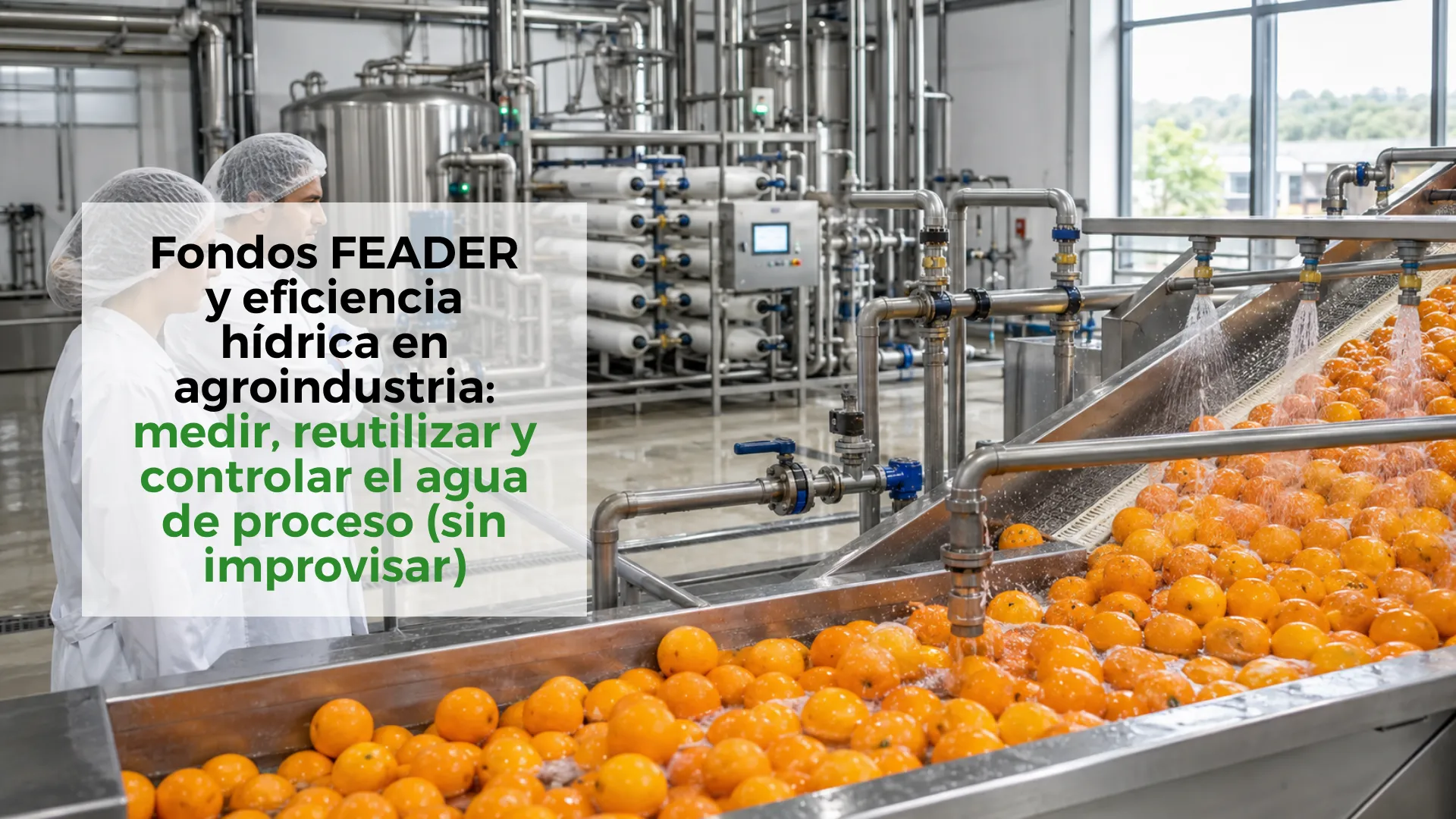
In a citrus fruit-and-vegetable packinghouse, water runs through the process as if it were a constant utility: washing, brushing, disinfection, rinses, drainage management and, in many plants, a downstream treatment system that suffers when contaminant load arrives in “spikes.” Here, water efficiency is achieved by avoiding waste without compromising hygiene or fruit quality. The first step is usually to organize consumption and reduce losses: detect leaks, stabilize pressures, adjust flows, and avoid permanent consumption that is maintained out of habit.
The second step, more strategic, is to act on reuse with industrial criteria. In citrus, not everything can be recirculated the same way, but it is possible to design an intelligent water-use scheme where each liter has a logical route: the “cleanest” water is reserved for stages that need it, and what is “recoverable” is used in pre-washes or compatible stages. When this is combined with appropriate filtration, turbidity control or quality parameters, and a treatment system that absorbs variability, the result is usually double: total consumption decreases and the plant’s operational stability improves.
In addition, in fruit-and-vegetable operations, wastewater treatment and discharge control are part of continuity. A well-designed water-efficiency approach does not end with “using less,” but with “managing better” the resulting waters, reducing load, stabilizing treatment, and preventing episodes that end in stoppages or emergencies.
IV range and V range: water is hygiene, and hygiene is process
In IV range and V range, water is not just a resource: it is a core element of food safety. Washes, disinfections, rinses, concentration controls, temperatures and times… everything is closely linked to sanitary requirements and audits. Here, the typical mistake is trying to reduce water by “cutting” without redesigning the process. Real efficiency appears when water is integrated into a controlled system: stable parameters, precise dosing, optimized rinses, and CIP cleaning designed to clean what is necessary, not “by excess.”
In this subsector, FEADER Funds tend to fit well when the project is framed as a process improvement: measurement by lines or stages, control of cleaning consumption, water recovery at technically viable points, and treatment that allows partial reuse without compromising safety. The key is that the file does not talk about savings “by intention,” but savings “by control,” supported by measurement, validation, and procedures. In IV/V range, water efficiency also tends to go hand in hand with waste reduction and quality stability: a stable hygienic process not only consumes less, it also produces more consistently.
Winery: water disappears into cleaning, transfers, and invisible losses
In a winery, water consumption often concentrates where people look least: tank washing, floor cleaning, open hoses, long rinses, transfer management, and a wastewater stream that can spike at specific moments. Water efficiency here usually improves when cleaning is governed with industrial discipline: controlled flows, adjusted procedures, reasonable times and, above all, measurement to know what is really happening.
Wastewater treatment in wineries is another key point. When organic load arrives in spikes, the treatment system suffers and the risk of incidents grows. Projects that stabilize the wastewater stream, separate streams, organize cleaning, and improve treatment performance often have a very real impact on continuity and costs, in addition to facilitating compliance and documentary traceability.
Olive mill: process water, cleaning, and discharges that require respect
In olive mills, water appears in cleaning, auxiliary services and, depending on the processes, in streams that require careful management. Here, water efficiency is worked with a control mindset: avoiding idle consumption, optimizing cleaning, improving circuits, and designing water and by-product management that doesn’t turn the campaign into a chain of urgencies.
In an olive mill, the treatment and downstream management side is often as important as consumption itself. A well-built FEADER project can be supported by measuring and stabilizing, separating streams, improving treatment systems, and documenting improvement consistently. In this sector, water efficiency translates into peace of mind: fewer scares, fewer stoppages, more control, and a better position in audits or environmental requirements.
How a FEADER water-efficiency project is won
The logic that works repeats itself: first you understand real consumption, then you act on the cause, and finally you prove the impact. With water, that means building a measurement baseline, defining what is corrected, how it will be controlled, and what evidence will remain afterwards. When the call becomes active, the advantage doesn’t go to whoever runs; it goes to whoever arrives with a complete project: coherent quotes, a clear technical report, and a “before and after” designed from the start.
At AGB Ingeniers we work on these projects with that mindset. Because a water investment should not be made only to “spend less,” but to produce with more stability, comply with greater peace of mind, and sustain growth without shocks.
Frequently asked questions about FEADER and water efficiency
What is water efficiency in the agri-food industry?
It is the ability to reduce consumption and variability of process water without compromising hygiene, quality, or food safety, relying on measurement, control, procedure optimization, viable reuse, and stable treatment.
Which projects tend to fit best in FEADER when we talk about water?
Those with industrial logic and demonstrability: measurement and control of consumption, cleaning optimization, separation and stabilization of streams, reuse where technically viable, treatment improvements, and systems that reduce spikes and losses.
How do you prove water savings “before and after”?
With a baseline of consumption and subsequent measurement, normalized by production or campaign. When you measure by areas or services and cross it with operational data, savings stop being an estimate and become evidence.
In which sectors is it usually most critical to work on water?
In all of them, but the focus changes: in citrus, washing and wastewater treatment weigh the most; in IV/V range, hygiene and control dominate; in wineries, cleaning and organic load typically dominate; in olive mills, controlling consumption and stable stream management are key.
When should you prepare the project if the call has not yet been published?
Now. Measuring, diagnosing, defining actions, and requesting coherent quotes takes time. In competitive calls, the difference is arriving with the project built, not improvising at the end.