
News
FEADER and Waste Reduction: How to Turn “Silent Scrap” into a Defensible (and Profitable) Project
- 11/05/2026
- Aids
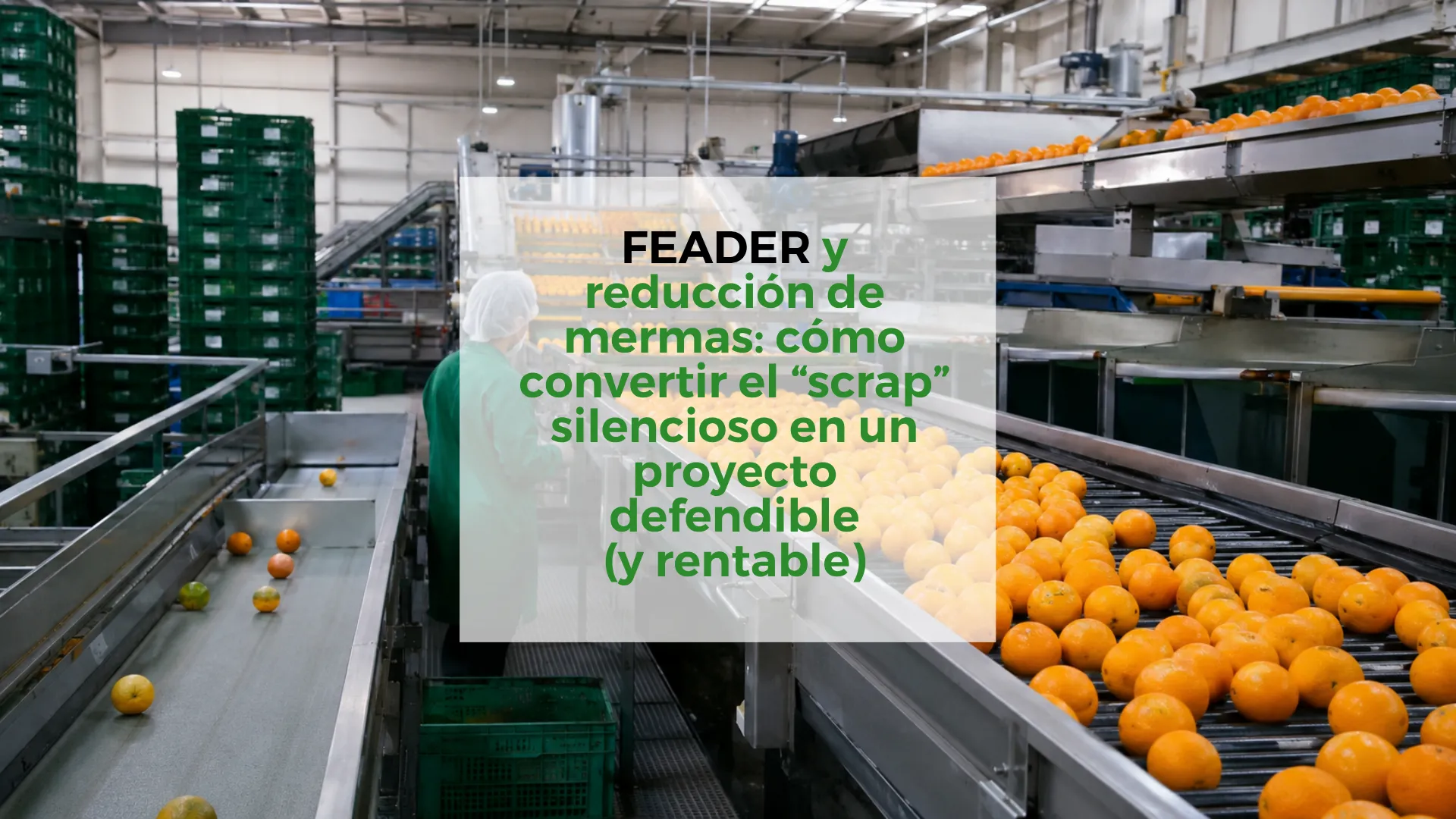
Waste is not just lost product: it’s unit cost, energy, rework, and the risk of claims. That’s why, when we talk about FEADER, waste reduction is an especially good fit when it is framed as a measurable, defensible project: identify where losses occur, act on the root cause (process, handling, in-line quality), and prove the before and after with data. Preparing it in time is the difference between competing… or improvising.
By Ana González, CEO and Agricultural Engineer – Industrial consultant in energy efficiency and grant management at AGB Ingeniers
In an agri-food or food plant, waste is rarely seen as a major problem… until it’s put into numbers. It is spread across small daily losses: product that doesn’t pass grading, units that are reworked, batches slowed down by deviations, packaging that is discarded, stoppages for adjustments, returns due to irregular quality. It doesn’t make noise, but it adds up. And when it adds up, it hits exactly where it hurts most: margin.
That’s why, when we talk about FEADER, waste reduction is one of the approaches with the best technical fit when it is framed for what it truly is: a measurable process improvement. It’s not “buying a machine” or “adding technology.” It’s stabilizing the process to produce more usable output, with less rework, fewer claims, and better service capacity during peak season.
In one sentence
A FEADER project aimed at reducing waste works when it connects three things: where the loss happens, what changes on the shop floor, and how the before and after are proven.
Waste is not just lost product: it’s time, energy, and credibility
In fruit-and-vegetable operations (especially citrus), waste shows up clearly: rejects due to size or defects, handling damage, line misadjustments, raw-material variability, inconsistent grading decisions between shifts, refrigeration or humidity issues that accelerate waste and claims. In IV/V range, waste blends with sanitary parameters, cutting, yields, time, and process control. In wineries or olive mills, the loss hides in blends, yields, losses during transfers, quality control, or process times. And in the food industry in general, waste tends to appear where the process speeds up, variability is not controlled, and quality is detected too late: during product-changeovers, packaging, labeling, shipping, and critical handling points.
The important thing to understand is that when there is waste, there is usually also rework, micro-stops, auxiliary consumption, and, in the worst case, claims. That’s why reducing waste is a double investment: it improves unit cost and it improves operational stability.
What fits best in FEADER: investments that tackle the cause, not the symptom
If a company tells me “we want to reduce waste,” my first response is not “what equipment do you want to buy,” but: where is it happening and why?.
In practice, the best-fit projects tend to focus on four levers:
1) In-line quality control (so you stop “discovering late”)
When control comes at the end, the waste has already happened. That’s why investments that allow earlier detection work very well: machine vision, dimensional control, defect detection, color or surface control, coherent reject systems. Not for “modernity,” but because they turn quality into a controlled process, not an interpretation.
2) Process stabilization (so quality stops varying by shift)
In agri-industry and the food industry, many losses come from variability: raw material, temperature, humidity, time, dosing, line synchronization. Improvements that stabilize parameters usually have direct impact: control tuning, sensors, demand-based automation, speed regulation, synchronization improvements, recipe control, or setpoints that stop depending on “habit.”
3) Handling and flow (when the problem isn’t the product, it’s the route)
In citrus, part of the waste doesn’t come from the fruit itself, but from impacts, drops, friction, accumulation points, or poor layout. In any plant, a flow that generates jams or micro-stops also generates indirect waste: it increases time, warms product, degrades quality, or drives rejects. Investments that improve flow, internal transport, and transfer points are often more profitable than they seem.
4) Traceability and data (because what isn’t measured repeats)
When a company records what happens well, it discovers patterns: which references generate more waste, which shifts have more rejects, which machines drift, which parameters go out of range. Many times, just by measuring and correcting with method, waste drops without massive investments. And if there is an investment, measurement makes it defensible.
How waste reduction is “defended” in a FEADER application file
This is where many projects are won—or lost. Reducing waste sounds good, but in an application file you have to demonstrate it with industrial logic. I always structure it in three steps:
1) Baseline (before): what waste looks like today
It doesn’t have to be perfect, but it does have to be honest and measurable. Reject percentage, kg/ton, rework, incidents, claims, associated downtime. If there is no data, you can start with a short measurement/submetering campaign precisely to build the baseline.
**2) Cause: why it happens and where it is generated
This is where shop-floor engineering shows. It’s not enough to say “there is a lot of waste.” You have to locate it: in which phase it appears, what drives variability, which flow points cause damage, which parameter triggers defects, which equipment is out of control, or what is missing to detect earlier.
3) Solution and proof (after): what is implemented and how it will be demonstrated
You explain the action (equipment + integration + commissioning + control) and define how impact will be measured: reject reduction, rework reduction, parameter stability, incident reduction, yield improvement by batch or by season.
The key is not to promise “magic savings.” In FEADER, what gives strength is a reasonable improvement, well explained and verifiable.
The typical mistake: treating waste as “a product problem”
I have seen many companies tackle waste with isolated purchases without solving the real cause: they buy technology but don’t tune the process; they change a machine but keep the flow that causes impacts; they install a control but don’t integrate it with operational discipline. Result: waste moves location, but it doesn’t disappear.
That’s why at AGB Ingeniers we work on waste reduction as a complete project: process, flow, control, measurement, and evidence. Because the goal is not “to have a new installation.” The goal is to produce with stability and margin.
Frequently asked questions about FEADER and waste reduction
What is considered “waste” in an agri-food or food industry?
It is the portion of product that is lost or degrades until it is no longer sellable in its target channel, and it includes rejects, rework, quality discards, and losses associated with the process.
Which investments usually reduce waste most effectively?
Those that allow earlier detection and process stabilization: in-line quality control (vision/sensors), automation and parameter control, flow/handling improvements, and measurement systems that turn waste into a manageable indicator.
How do you prove waste reduction in a project?
With a “before” baseline (percentage or kg of rejects/rework) and an “after” measurement, normalized by production (tons, batches, shifts/season). If it is supported with process and quality records, the improvement becomes evidence.
Which indicators are most robust to justify impact?
Reject percentage, kg of waste per ton processed, hours of rework, incidents per reference, returns/claims, and stability of critical process parameters.
When should you prepare a project if there is still no active call?
Beforehand. Measuring a baseline, defining the cause, and requesting coherent quotes takes time. When the window opens, the advantage is arriving with the project built, not improvising.