
News
FEADER and Food Traceability: How to Turn Batch Control into a Defensible (and Fundable) Project
- 04/05/2026
- Aids
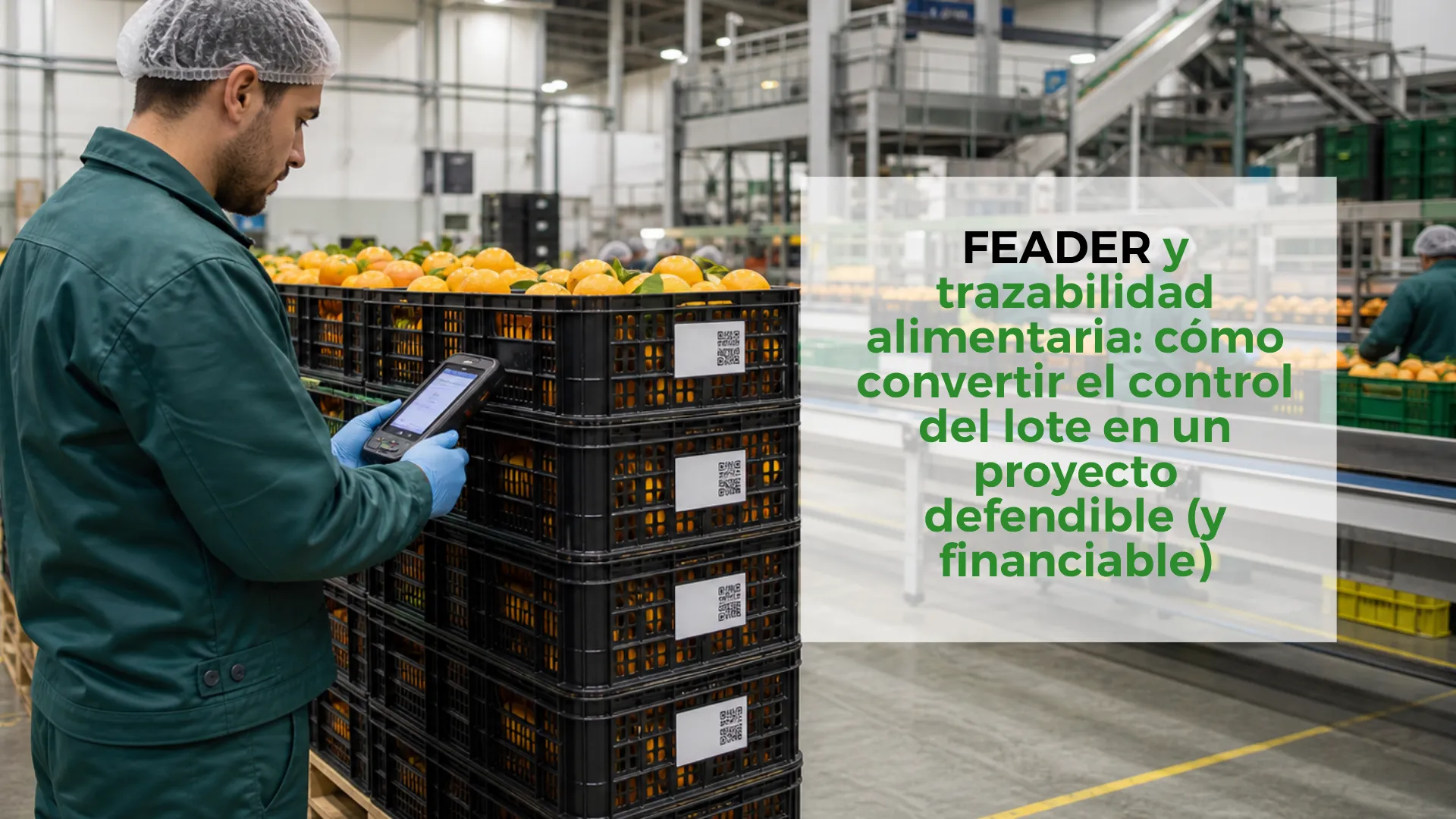
In the agri-food industry food traceability is no longer just about compliance: it’s about protecting your brand, responding to audits, and keeping process control during peak season. That’s why, when we talk about FEADER, traceability is an especially good fit when it’s approached as a defensible industrial project, not as “software.” Data capture at critical points, in-line integrated labeling, ERP/MES connectivity, and before-and-after evidence turn the batch into a real thread of control. Preparing it in time is the difference between competing… or improvising.
By Ana González, CEO and Agricultural Engineer – Industrial consultant in energy efficiency and grant management at AGB Ingeniers
In the agri-food industry there is a concept that comes up in every important meeting, even if it’s sometimes said quietly: traceability. Traceability is no longer just a regulatory requirement. It’s the foundation on which customer trust, supply-chain continuity, and management peace of mind are built when an audit arrives. And precisely for that reason, when we talk about FEADER, traceability shouldn’t be left as an “IT improvement.” When it’s well designed, traceability can become a solid industrial project, measurable and defensible.
I see it every season in fruit-and-vegetable plants, IV/V range facilities, wineries, olive mills, and processing industries. Day-to-day pressure is relentless: raw-material intake, product-changeovers, shifts, shipping pressure, peak-season spikes, and claims that must be resolved fast. In that rhythm, traceability becomes a thermometer: when it works, the factory flows; when it fails, everything becomes slow, unsafe, and expensive.
That’s why, if your company is thinking about FEADER and wants to prepare investments with real purpose, my recommendation is clear: talking about traceability means talking about process, not just software. And that is why it fits so well when it is approached with method.
In one sentence
A traceability project with FEADER fit is not “installing a program”: it is designing a system that connects batches, process, and evidence to produce with control and pass audits with peace of mind.
Real traceability: from the batch to “why it happened”
Many companies believe they have traceability because they can assign a batch to an outgoing shipment. And that, in reality, is only the beginning. The traceability that makes the difference is the one that allows you to answer, with data, three questions:
What came in and under what conditions.
What happened during the process.
What went out and why that output is consistent with what came before.
When a customer files a claim or an auditor asks a question, “we think it was on that shift” isn’t enough. You need to be able to prove it. And this is where traceability becomes competitiveness. Because a company that responds quickly, with evidence, reduces risk, avoids massive returns, and protects its brand.
At AGB Ingeniers I always frame it like this: the goal is not “to have traceability.” The goal is to have process control that can be demonstrated.
Which traceability investments tend to fit best in agri-industry
For a traceability project to have strength in FEADER, it must be connected to real operations. A tool is not enough. There must be integration.
In fruit-and-vegetable plants, for example, solid traceability usually relies on data capture at critical points: receiving, grading/sorting, packing, palletizing, and shipping. In IV or V range, process parameters, sanitary controls, and records that must be consistent are also involved. In wineries and olive mills, traceability runs through tanks, batches, blends, time, and quality controls.
That’s why the best-fit investments typically combine several layers: batch identification, automated recording, integration with existing systems, and event traceability.
The identification layer can be supported by labeling, barcodes, or more advanced systems, but the key point isn’t the “code.” The key point is that the code translates into useful information within the process.
Automating records is another highly profitable lever: when traceability depends on manual notes, sooner or later it fails. Not out of bad faith, but because of pace. Reducing paper and capturing data in real time, without friction, is usually an immediate operational improvement.
And then there is integration: ensuring information doesn’t live on islands. When traceability, production, and warehouse don’t communicate, control fragments. By contrast, when they are integrated (ERP, MES, or well-designed intermediate tools), the batch stops being a label and becomes a guiding thread through the process.
How to defend a traceability project within FEADER
This is where many companies lose strength. Traceability is presented as a “technological improvement” and stops there. And for FEADER to fit well, traceability must be explained for what it is: an industrial improvement with impact.
In a defensible file, traceability is justified from the real need: audits, customer requirements, claims management, production control, waste reduction, error reduction, and improved response times.
Then you explain how it will be implemented: where information is captured, what data is recorded, how batches are linked to processes, how labeling is managed, which points of the flow are covered, which controls are automated, and how consistency is guaranteed.
Finally, you explain how impact will be measured. And this is where the project wins. Because well-measured traceability translates into clear indicators: fewer labeling errors, less time locating batches, fewer shipping incidents, lower impact of claims, faster audits, less rework due to missing information.
When a company frames it this way, traceability stops sounding like “software” and starts sounding like “the shop floor.”
Traceability is also infrastructure
There is a part that often gets overlooked and that matters greatly in agri-industry: for traceability to be real, sometimes you need to invest in supporting infrastructure. I’m not only talking about devices. I’m talking about connectivity, capture points, process order, and documentary coherence.
In a packinghouse with peak-season spikes, for example, a digital system only works if it is robust: if the network holds, if equipment is used without friction, if labeling is integrated into the flow, and if there is a clear criterion for who validates what. Traceability is not implemented with a meeting. It is implemented with method and real integration into operations.
And this is important in FEADER grants applications because a solid project must reflect that reality. A traceability system that “exists” but isn’t used is a cost. One that is integrated into the daily routine is a transformation.
The AGB Ingeniers approach: traceability as an industrial advantage, not a formality
At AGB Ingeniers we approach traceability from a simple idea: if a project doesn’t improve the plant, it doesn’t deserve to be called a project. That’s why, when we prepare traceability for FEADER fit, we don’t start with software. We start with the process: the real flow, the critical points, the risks, the operational discipline, and how the improvement will be demonstrated.
And that approach, besides strengthening the file, improves the company. Because an industry that traces well doesn’t just comply. It produces better, responds faster, suffers less during audits, and protects its reputation when incidents occur.
If your agri-food company wants to take a leap in traceability and turn it into a defensible project, this is a good moment to work on it calmly. Because when FEADER becomes active, what matters won’t be rushing. What will matter is arriving with a project that is understood, sustainable, and demonstrable.
Frequently asked questions about traceability and FEADER
What is food traceability and why is it key in agri-industry?
It is the ability to track a product by batches from raw-material intake to shipping, including what happens during the process. It is key because it reduces risk, speeds up responses to claims, and provides solid evidence in audits.
Which traceability improvements tend to fit best in FEADER?
Those that connect batches with process and evidence: data capture at critical points, automated records, in-line integrated labeling, and systems that enable audit and real traceability in near real time.
How do you prove the impact of a traceability investment?
With operational indicators: fewer labeling errors, reduced time to search for batches, better response time to claims, fewer shipping incidents, and greater agility in audits thanks to consistent records.
Is it enough to install traceability software?
No. The value lies in implementation: what data is captured, where, who validates it, and how it is integrated into the flow. Traceability is process + data + operational discipline, not just a tool.
What documentation should you keep to justify a project?
Evidence of implementation and use: system configuration, internal procedures, generated records, batch traceability samples, training evidence, and before/after comparisons in indicators.
When should you prepare a project if there is still no call?
Beforehand. Defining the flow, choosing critical points, and preparing coherent quotes lets you arrive with an advantage when the window opens and avoids improvisation that weakens the file.